
Something Big IS Happening
The real job-loss conversation we need to have... without panic, denial, or hype

A recent essay by AI developer Matt Shumer has amplified a growing anxiety: that AI may fundamentally disrupt white-collar jobs faster than we’re prepared for. The fear isn’t irrational — AI capability is accelerating.
But the bigger risk isn’t only mass unemployment. It’s psychological destabilization. The organizations and professionals who thrive won’t be the ones who panic or deny the shift. They’ll be the ones who deliberately evolve by pairing AI adoption with skill development, emotional steadiness, and human judgment.
Let’s talk about it…
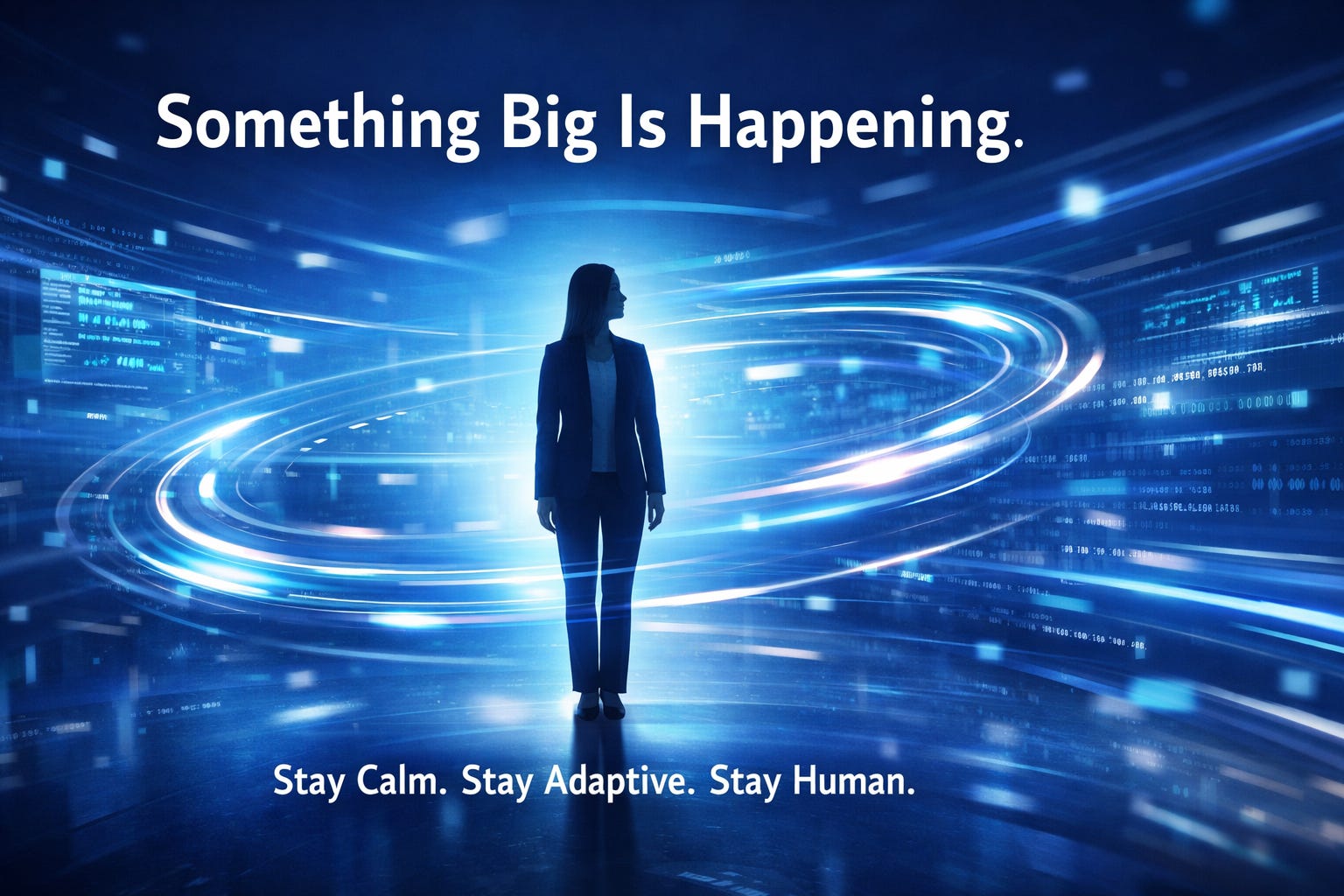
Over the past couple of weeks, an essay by Matt Shumer — I likened it to a prophetic manifesto — titled “Something Big Is Happening” has spread rapidly across tech media, striking fear into the hearts and minds of many people, especially knowledge workers.
The headline message?
Something big is happening with AI, and most people aren’t prepared.
Shumer argues that recent model improvements aren’t incremental — they’re exponential. In his telling, AI is no longer just assisting software engineers. It’s doing meaningful portions of their work independently. (Case in point: Spotify says its developers haven’t written a line of code in the last six months.)
And if that’s happening in engineering, he suggests it’s only a matter of time before it reaches law, finance, consulting, marketing, writing — any job that “happens on a screen.”
Shumer’s message landed hard because it touches the nerve everyone feels but few want to articulate:
What if this time, the automation really does come for knowledge work?
If that’s not enough to put the fear of AI in you, Dario Amodei, CEO of Anthropic, told Axios that AI could wipe out half of all entry-level white-collar jobs and spike unemployment to 10-20% in the next one to five years.
And if that doesn’t do it, Microsoft AI chief executive Mustafa Suleyman said artificial intelligence could replace most white-collar work within 12 to 18 months!

First: The Fear Is Not Irrational
When inside-tech founders say, “I no longer need to do parts of my own job,” people listen.
And they should.
AI systems are improving rapidly. In certain task domains — coding, summarization, drafting, analysis — productivity gains are measurable. Some teams are already experimenting with leaner staffing models because AI reduces task load.
That doesn’t mean mass unemployment tomorrow. But it does mean this is no longer theoretical.
The anxiety many professionals feel right now isn’t hysteria. It’s pattern recognition. And dismissing that fear as “tech panic” is unhelpful.
Second: Acceleration ≠ Instant Labor Collapse
History matters.
Every major technology wave — electricity, mechanization, computers, the internet — displaced tasks before it displaced entire professions. Over time, job composition changed more than total employment levels.
AI appears to be following a similar early pattern:
Replacing portions of workflows
Compressing junior-level work
Elevating productivity expectations
Redefining what “entry-level” even means
For example, IBM is tripling its hiring of entry-level jobs, bucking industry trends — so go figure. Whether that’s an anomaly remains to be seen.
That said, the most immediate risk zone isn’t all white-collar work. It’s repeatable cognitive labor.
The more templated and pattern-based your work is, the more automation pressure you’re likely to feel.
That’s uncomfortable, but it’s not the same as “everyone is losing their job.”

The Wellness Dimension We’re Not Talking About Enough
Here’s what concerns me more than automation itself: The psychological destabilization of the workforce.
When workers hear:
“AI is coming for your job.”
“50% of white-collar work could disappea.r”
“If you work on a screen, you’re nex.t”
…it activates the nervous system.
Fight.
Flight.
Freeze.
We’re seeing early signs of what I call anticipatory technostress — stress not from AI replacing you, but from the fear that it might.
This leads to:
Hyper-productivity and burnout (“I have to prove I’m still valuable.”)
Imposter syndrome amplified by AI speed
Skill panic (“Am I already behind?”)
Quiet disengagement masked as “efficiency.”
The deeper issue isn’t AI capability.
It’s identity disruption.
Work is not just income — it’s meaning, contribution, status, and stability. When that feels threatened, the stress becomes existential.
So… Is Mass Job Loss Coming?
The honest answer? We don’t know the scale or the timeline.
We do know:
Some entry-level roles will shrink.
Some middle-skill knowledge jobs will compress.
New hybrid roles will emerge.
Organizations will experiment before they stabilize.
We are in the experimentation phase, not the equilibrium phase. That’s inherently unstable. But unstable does not mean catastrophic. It means adaptive pressure is rising.
The Strategic Response (For Individuals)
If you work in a screen-based profession — marketing, HR, writing, consulting, finance, SaaS, operations — here’s the shift to consider:
Move from Task Value → Judgment Value
AI is excellent at:
Generating drafts
Processing patterns
Automating repeatable sequences
AI is weaker at:
Contextual judgment
Organizational politics
Cross-functional alignment
Emotional nuance
Strategic prioritization under ambiguity
The future advantage isn’t “doing tasks faster,: it’s:
Framing the right problems
Interpreting AI outputs wisely
Knowing what not to automate
Communicating meaningfully with humans
That’s augmentation, not denial.
The Strategic Response (For Leaders)
Leaders need to understand something critical: The way you talk about AI adoption will directly affect workforce wellbeing.
If AI is framed primarily as:
Cost reduction
Headcount trimming
Efficiency maximization
You will trigger defensive culture.
If AI is framed as:
Capacity extension
Skill amplification
Burnout reduction
Creative leverage
You create psychological safety.
Same tool. Different nervous system outcome.
AI governance and AI wellness are inseparable.
The Real Risk: Narrative Collapse
The biggest threat right now isn’t that AI replaces everyone overnight.
It’s that the narrative becomes so extreme — in either direction — that people disengage.
Some deny change entirely.
Some panic prematurely.
Some freeze.
The healthier posture is steadiness.
Yes, something big is happening. But big does not automatically mean destructive. It means structural. And structural change requires leadership, skill development, and emotional regulation.
What I’m Watching Closely
Three indicators matter more than viral posts:
Entry-level hiring trends
Corporate AI integration budgets vs. layoff ratios
Upskilling investment patterns
When AI adoption outpaces investment in reskilling, technostress spikes.
When organizations pair AI integration with literacy training, wellness outcomes stabilize.
This is where the AI Technostress Framework becomes practical, not theoretical.
A Steadying Thought
If you feel the tremor, you’re not crazy. If you see the shift coming, you’re not an alarmist. But we do ourselves no favors by catastrophizing.
The future of work is being reshaped, but that doesn’t mean your career disappears. It means your value proposition evolves.
The real question isn’t “Will AI take my job?”
It’s: “How do I remain valuable in an AI-accelerated environment without burning out in the process?”
That’s the workplace wellness question of this decade. And it deserves clarity, not panic.
If you feel this conversation raises deeper questions about your career future, check out my newsletter, The Connected Life.
Why? Because the skills required to stay steady in an AI-accelerated workplace are not just technical. They are emotional. Relational. Grounded. And those capacities begin long before we open a laptop.
The Connected Life discusses how to choose faith over fear and stay securely grounded in an increasingly unstable world.
Upcoming: For the most part, this newsletter has focused on workplace wellness for employers. In the next few weeks, I will be running a three-month-long series about its impact on employees. Stay tuned.
We always value your input. Feel free to leave a comment and let us know what you think. Is something big happening?
While you’re at it, we’d love it if you would…